Field notes · vol. 05 · the discovery motion

20 AI Prompts for Discovery Calls

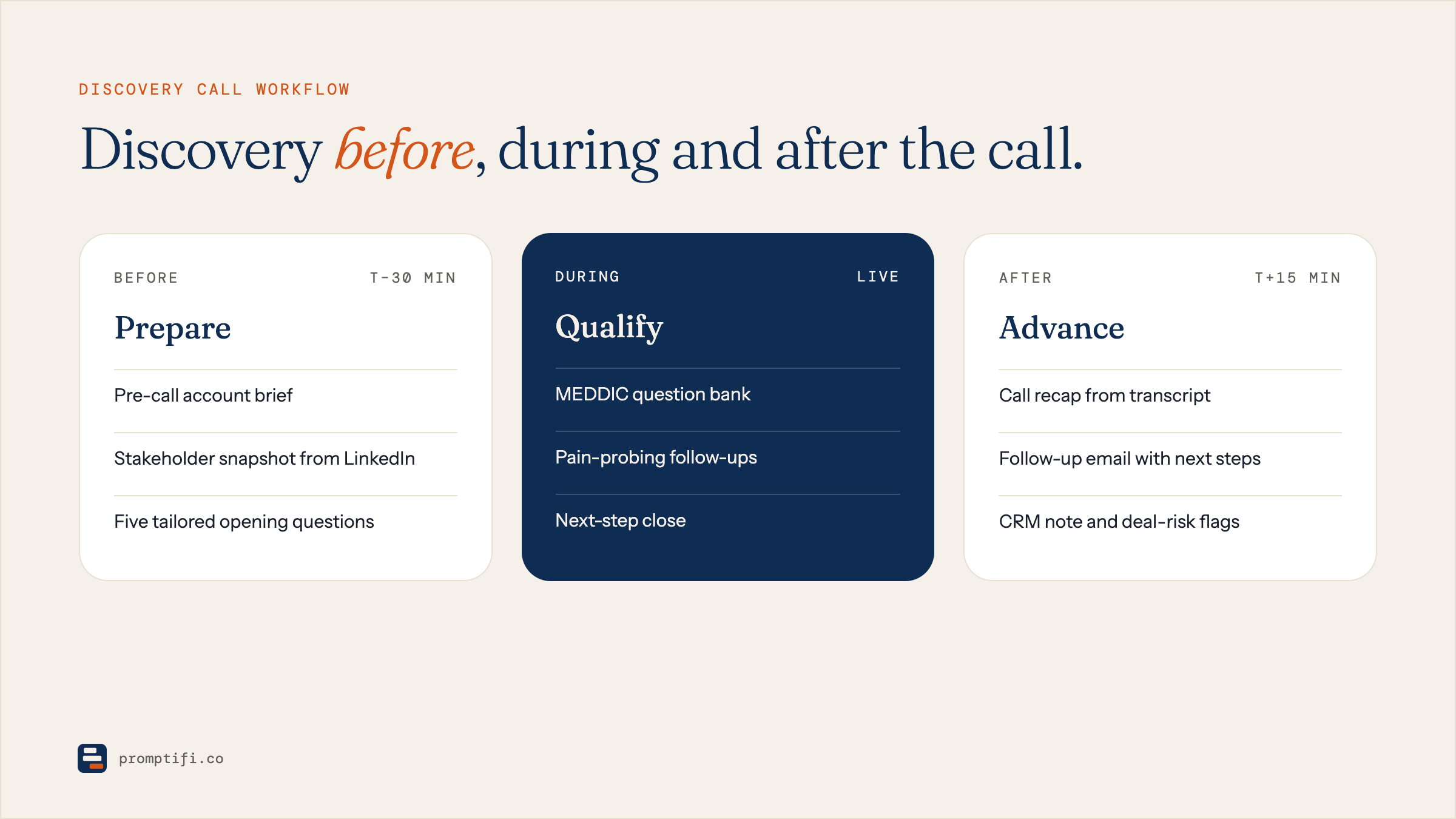
AI prompts for discovery calls work best when they cover the whole motion, not just the questions. This page holds 20 free, copy-paste prompts: five that build your pre-call brief, seven questions labeled by the signal each one uncovers, four for live-call moments, and four that score the transcript against the same seven signals. Every prompt is complete — no signup, no truncation.

Last updated: August 2026 20 prompts · copy-paste · free

01.

The pre-call brief

Five prompts that turn scattered research into a plan you can hold. Run them the night before — they feed every question you ask tomorrow.

  1. No. 01

    The one-page account brief

    Use this when the call is at the top of the hour and your research is 40 open tabs.

    • SDR · AE
    • Pre-call
    • Any model
    You are prepping an account executive for a discovery call with [PROSPECT COMPANY], a company in [INDUSTRY]. Using the raw notes I paste below, build a one-page pre-call brief with exactly five sections: 1) What they sell and to whom, in two sentences. 2) Three things that changed for them recently — funding, hires, product moves, layoffs. 3) The problem [YOUR PRODUCT] most plausibly solves for them, stated as a hypothesis, not a fact. 4) Two open questions my research cannot answer. 5) One sentence I could say in the first two minutes that proves I did my homework without sounding rehearsed.
    
    Constraints: 220 words maximum, plain language, no marketing adjectives, no claims my notes do not support. If my notes are too thin to fill a section, write NEEDS RESEARCH under it instead of inventing.
    
    Raw notes: [PASTE RESEARCH NOTES]
    View full prompt details →
  2. No. 02

    The persona pressure map

    Use this when you know the title on the invite but not the person behind it.

    • AE
    • Pre-call
    • Any model
    Act as a [PERSONA] at a [COMPANY SIZE] company in [INDUSTRY] — the actual person, not a consultant describing them. I sell [YOUR PRODUCT] and I have a discovery call with you in an hour.
    
    Write your private worry list: the five pressures most likely on your mind this quarter, ranked, each in one sentence written in first person ("I'm behind on…"). For each pressure, add: (a) the metric your boss checks, and (b) the phrase you'd use to describe the pain to a peer — casual language, not vendor language.
    
    Then break character and tell me which two pressures [YOUR PRODUCT] can honestly touch, and which three I should leave alone on a first call.
    
    Constraints: no generic pressures like "doing more with less" unless you tie it to a specific metric; 200 words maximum.
    View full prompt details →
  3. No. 03

    Three testable hypotheses

    Use this when your research is done and you need something to test, not recite.

    • AE
    • Pre-call
    • Any model
    Before my discovery call with [PROSPECT COMPANY], turn my research into three problem hypotheses I can test live. I sell [YOUR PRODUCT]. Research summary: [PASTE RESEARCH SUMMARY].
    
    For each hypothesis, give me: 1) The hypothesis in one sentence, specific enough to be wrong — "their SDR team is hand-building lists because their enrichment tool lost budget," that level of specific. 2) The single question that tests it fastest. 3) What a confirming answer sounds like, and what a disconfirming answer sounds like, one line each. 4) The follow-up I ask if it confirms.
    
    Order them from most to least likely based on the research.
    
    Constraints: every hypothesis must be falsifiable on one call; no hypothesis may simply restate my product's value proposition; 230 words maximum.
    View full prompt details →
  4. No. 04

    The trigger-event angle

    Use this when the prospect just raised, launched, hired, or cut — and you want the angle, not the applause.

    • SDR
    • Pre-call
    • Any model
    Turn a recent trigger event into a discovery-call opening angle. The prospect: [PROSPECT COMPANY], in [INDUSTRY]. The event: [RECENT NEWS OR SIGNAL] — funding round, leadership change, product launch, expansion, layoffs, whatever I paste.
    
    Give me three angles. Each angle has: a one-sentence read on what the event probably means operationally for a [PERSONA] — their likely new problem or priority, not the press-release version; a natural first-two-minutes line that references the event without flattery theater; and the discovery question it sets up.
    
    Rank the angles by how safely they land if my read is wrong.
    
    Constraints: no lines that start with "Congrats"; do not assume the event is good news for my product — if it could plausibly mean a budget freeze, say so and give me the adjusted angle. 200 words maximum.
    View full prompt details →
  5. No. 05

    The index-card call plan

    Use this when you over-prepare and then wing it anyway.

    • AE
    • Pre-call
    • Any model
    Build me a call plan that fits on one index card, for a [CALL LENGTH]-minute discovery call with a [PERSONA] at [PROSPECT COMPANY]. I sell [YOUR PRODUCT].
    
    Format, exactly:
    GOAL — the single thing I must know by the end, one line.
    OPENER — my first 30 seconds, word-for-word, ending in a question.
    SPINE — four questions in the order I'd ideally ask them, with five words maximum of stage direction each.
    LANDMINES — two topics to avoid or handle carefully, with why.
    FALLBACK — what I go for if my goal dies in the first ten minutes.
    NEXT STEP — the specific ask I close with, word-for-word.
    
    Constraints: 170 words maximum for the whole card; the opener may not mention my product; the next-step ask must name a date, an artifact, or a person — never "circle back."
    View full prompt details →
02.

The question bank: seven AI prompts for discovery calls, labeled by what they uncover

Each prompt generates questions tagged with the signal they surface — and each signal feeds a numbered row of the scorecard in section 04. Ask with a label, score with the same label.

  1. No. 06

    The pain excavation set

    Use this when prospects tell you things are "fine" and you know they are not.

    • AE
    • Discovery
    • Question set

    uncovers: pain→ feeds scorecard row 1

    Generate 8 discovery questions that surface PAIN for a [PERSONA] at a company in [INDUSTRY], relevant to the problems [YOUR PRODUCT] solves. Label every question with the layer of pain it uncovers: SURFACE (the annoyance they'll admit immediately), OPERATIONAL (the workflow it breaks), or PERSONAL (what it costs them — hours, credibility, sleep). At least two questions per layer.
    
    Format each as: the question → the label → a one-line follow-up to use if the answer is vague.
    
    Constraints: no question may contain my product's name or category; no "what keeps you up at night"; every question must be answerable by someone who has never heard of me; plain spoken English a rep can say out loud without sounding like a survey. 230 words maximum.
    View full prompt details →
  2. No. 07

    The cost-of-inaction probes

    Use this when the pain is admitted but nobody has done the math on it.

    • AE
    • Discovery
    • Question set

    uncovers: stakes→ feeds scorecard row 2

    Write 7 discovery questions that quantify STAKES — what the problem costs [PROSPECT COMPANY] if nothing changes. Context: I sell [YOUR PRODUCT]; the pain we've likely surfaced is [SUSPECTED PAIN].
    
    Label each question with the cost type it uncovers: TIME (hours burned), MONEY (spend or lost revenue), RISK (what breaks or gets missed), or MOMENTUM (what they can't start because of it). Cover all four types. For each question, add the arithmetic I should do out loud with their answer — "12 hours a week × 4 reps × …" — so the cost lands in the room, not in my follow-up email.
    
    Constraints: questions must feel like curiosity, not a trap; never ask them to guess a number they'd need finance for — give an easier proxy instead; no more than 20 words per question. Output as a labeled list, 220 words maximum.
    View full prompt details →
  3. No. 08

    The current-process walkthrough

    Use this when you need the workflow map they would never draw for you on a slide.

    • AE · SE
    • Discovery
    • Question set

    uncovers: process→ feeds scorecard row 3

    Build a walkthrough script that maps PROCESS — how [PROSPECT COMPANY] handles [WORKFLOW OR TASK] today, end to end. Give me 7 questions in walking order, starting from the trigger ("what kicks this off?") to the finish line ("how do you know it worked?").
    
    Label each question with what it exposes: TOOLS (what they use), HANDOFFS (where it changes hands), WORKAROUNDS (the duct tape), or OWNERS (who touches it). Include at least one WORKAROUNDS question — that is where deals live.
    
    After the questions, add two listening cues: phrases that signal a workaround they've stopped noticing, like "and then we just export it to a spreadsheet…"
    
    Constraints: conversational phrasing, no audit tone; each question should build on an imagined previous answer so the set flows as a conversation, not a checklist. 220 words maximum.
    View full prompt details →
  4. No. 09

    The buying-committee mapper

    Use this when "I'd have to check with my team" keeps ending your deals.

    • AE
    • Discovery
    • Question set

    uncovers: people→ feeds scorecard row 4

    Write 7 questions that map PEOPLE — the buying committee at [PROSPECT COMPANY] — without ever using the words "decision maker," "budget holder," or "buying process."
    
    Label each question with what it uncovers: AUTHORITY (who signs), INFLUENCE (whose opinion moves it), VETO (who can kill it quietly), or HISTORY (how the last similar purchase actually went). Cover all four labels. Each question must be askable of a [PERSONA] on a first call without making them feel small if the answer is "not me." For each, add a one-line read on what a hesitant answer usually means.
    
    Constraints: no procurement jargon; phrase questions around how work gets done and how the last tool got bought, not around org charts. Output as a labeled list, 220 words maximum.
    View full prompt details →
  5. No. 10

    The money conversation openers

    Use this when the money question sits in your throat for the whole second half of the call.

    • AE
    • Discovery
    • Question set

    uncovers: money→ feeds scorecard row 5

    Give me 6 ways to open the MONEY conversation on a discovery call with a [PERSONA] at [PROSPECT COMPANY] — none of which is "what's your budget?"
    
    Label each with what it uncovers: SPEND (what they pay today for the problem — tools, headcount, agencies), APPETITE (what a fix would be worth to them), or PATH (how money for something like this actually gets approved). At least two per label. For each: the exact phrasing, when in the call to use it, and the graceful exit line if they stiffen.
    
    Constraints: phrasing must let them answer in ranges or comparisons, never demand a number; no apologizing before the question — "I hate to ask, but…" is banned; each question 15–25 words. 210 words maximum.
    View full prompt details →
  6. No. 11

    The timeline reality check

    Use this when every deal is "a priority this quarter" and half of them never move.

    • AE
    • Discovery
    • Question set

    uncovers: timing→ feeds scorecard row 6

    Write 6 questions that test TIMING — whether [PROSPECT COMPANY] will actually move on this problem or is just browsing.
    
    Label each with what it uncovers: FORCING EVENT (a date that makes waiting expensive — a renewal, a launch, an audit, a hiring plan), SEQUENCE (what has to happen before they could buy anything), or DRIFT (evidence this has been "a priority" for three quarters without movement). For each question, add what a real answer sounds like versus a polite answer, one line each — I need to hear the difference live.
    
    End with one summary line: which single label predicts close dates best for a product like [YOUR PRODUCT], and why.
    
    Constraints: no pressure phrasing and no invented time pressure; curiosity tone throughout. 220 words maximum.
    View full prompt details →
  7. No. 12

    The status-quo autopsy

    Use this when your real competitor is a spreadsheet and nobody will say so.

    • AE
    • Discovery
    • Question set

    uncovers: rivals→ feeds scorecard row 7

    Generate 7 questions that expose RIVALS — everything competing with me for this deal at [PROSPECT COMPANY]: named competitors, the in-house spreadsheet, the intern who "handles it," and doing nothing at all.
    
    Label each question with the rival it uncovers: VENDOR (a competitor is in the building), HOMEGROWN (they built or cobbled something), or INERTIA (nobody owns the problem, so nothing moves). Cover all three. For each, add the follow-up I ask when the answer reveals that rival, and one line on how it changes my next call.
    
    Constraints: never ask "are you looking at competitors?" — every question comes at it sideways, through their workflow and their history; no disparaging any rival, including the spreadsheet. Output as a labeled list, 230 words maximum.
    View full prompt details →
03.

Live-call assists

Four prompts built for the side window while the call is still happening. Ten-second answers, spoken English, best option first.

  1. No. 13

    The mid-call redirect

    Use this when the call has drifted three tangents from anything you can sell.

    • AE
    • Live call
    The discovery call is drifting and I need it back. Here is the situation: [WHAT JUST HAPPENED ON THE CALL] — they went deep on an irrelevant feature, a second stakeholder joined late and restarted everything, it turned into a support call, whatever I paste.
    
    Give me three redirect moves. Each move has: the exact sentence I say next, word-for-word, 25 words maximum; why it works, one line; and the risk if it lands wrong, one line. One move should honor the tangent and bank it ("I want to come back to that…"), one should name the drift directly, and one should use a question to steer.
    
    Constraints: no fake-polite filler — "that's a great point, but…" is banned; nothing that scolds the prospect; conversational spoken English only. I will pick one and say it in the next ten seconds, so lead with your best.
    View full prompt details →
  2. No. 14

    The follow-up engine

    Use this when they just said something interesting and you have ten seconds to go deeper.

    • AE
    • Live call
    • Side window
    I just got this answer on a live discovery call: [PROSPECT'S ANSWER].
    
    Give me three follow-up questions, ranked, that dig one layer deeper — each 20 words or fewer, each pointed at a different layer: 1) SPECIFICS — pin the vague part to a number, a name, or a last-time-it-happened. 2) IMPACT — what that answer costs or breaks downstream. 3) FEELING — how they personally experience it, asked without therapy voice. For each, add one line on what I am listening for in their reply.
    
    Then flag it: if the answer I pasted contains a buying signal, a landmine, or a contradiction with what is typical for [INDUSTRY], say so in one sentence.
    
    Constraints: spoken English, no jargon, nothing that repeats their words back verbatim like a call-center script. Speed matters — best question first.
    View full prompt details →
  3. No. 15

    The monologue breaker

    Use this when you hang up and realize you did most of the talking. Again.

    • AE · SDR
    • Live call
    My discovery calls keep tipping into monologue — I talk, they nod. Build me a live rescue kit for the moment I catch myself pitching:
    
    1) Three hand-back lines that return the ball naturally, word-for-word, 15 words maximum each — "I've been talking too long; where does that land against how you do it today?" is the register.
    2) Two silence rules: when to stop talking and how long to wait, in seconds.
    3) Three open questions that restart their side of the conversation, each tied to something a [PERSONA] at a [COMPANY SIZE] company in [INDUSTRY] actually cares about.
    4) One tell that I am doing it again, phrased so I can self-check mid-sentence.
    
    Constraints: nothing gimmicky, no scripted vulnerability; every line must survive being said in my voice on a Tuesday afternoon. 180 words maximum.
    View full prompt details →
  4. No. 16

    The next-step builder

    Use this when the call went well and "I'll send some info" is about to waste it.

    • AE
    • Live call
    Build my end-of-call ask. Here is what the discovery call uncovered, in my rough notes: [WHAT THE CALL UNCOVERED]. I sell [YOUR PRODUCT].
    
    Give me three candidate next steps, ranked by how much deal momentum each creates. Each has: the ask, word-for-word, ending in a question; the specific evidence from my notes that earns it — quote my note back to me; and the fallback version if they hesitate, a smaller commitment in the same direction. Every ask must name at least two of: a date, a named person to include, an artifact one of us brings.
    
    Constraints: "I'll send over some information" is banned as an ask; if my notes show we never confirmed a problem worth demoing, do not propose a demo — call that out instead and give me the honest alternative. 200 words maximum.
    View full prompt details →
04.

Scoring & follow-through

Four prompts that eat the transcript. The seven signals you asked about in section 02 come back here as seven scorecard rows — the red string below shows the wiring.

PAINrow 1 STAKESrow 2 PROCESSrow 3 PEOPLErow 4 MONEYrow 5 TIMINGrow 6 RIVALSrow 7 No. 17 THE SCORECARD rows 1–7 · scored 0–2 verbatim evidence only No. 18 THE GAP AUDITOR No. 19 THE FOLLOW-UP EMAIL No. 20 COACH'S MARGIN NOTES
Every labeled question feeds a scorecard row. The rows feed the follow-through. Nothing asked, nothing scored.
  1. No. 17

    The seven-signal scorecard

    Use this when the call felt great and you want to know if it actually was.

    • AE · Manager
    • Post-call
    • Long context

    pulls → all seven signals from [CALL TRANSCRIPT]

    Score this discovery call against seven signals: PAIN, STAKES, PROCESS, PEOPLE, MONEY, TIMING, RIVALS. Transcript: [CALL TRANSCRIPT].
    
    For each signal, output one row: a score of 0 (never surfaced), 1 (mentioned, not explored), or 2 (explored down to a specific fact) — then the single strongest supporting quote from the transcript, verbatim and attributed, or the word SILENT if nothing qualifies.
    
    After the seven rows: TOTAL out of 14; the one signal whose absence most threatens this deal; and the single question that would have raised the score most, written so I can ask it in the follow-up.
    
    Constraints: quotes must be verbatim from the transcript — paraphrase never counts as evidence; do not award a 2 because the rep asked, only because the prospect answered with a specific; keep the whole output under 250 words.
    View full prompt details →
  2. No. 18

    The gap auditor

    Use this when you replay the call in the shower and keep finding questions you didn't ask.

    • AE
    • Post-call
    • Long context

    pulls → the dropped threads behind rows 1–7

    Audit this discovery call for what I failed to ask. Transcript: [CALL TRANSCRIPT]. I sell [YOUR PRODUCT].
    
    Step 1: list the threads the prospect opened that I never pulled — a verbatim quote fragment for each, with a one-line read on what was probably behind it.
    Step 2: mark which of the seven signals (PAIN, STAKES, PROCESS, PEOPLE, MONEY, TIMING, RIVALS) each dropped thread would have fed.
    Step 3: for the three most expensive gaps, write the recovery question I can ask in a follow-up email without it feeling like an interrogation — framed as a thought I had after the call.
    
    Constraints: only flag threads that actually appear in the transcript; if I genuinely covered everything, say so instead of inventing gaps; recovery questions 25 words maximum each; 230 words maximum overall.
    View full prompt details →
  3. No. 19

    The evidence-only follow-up email

    Use this when the follow-up email deserves better than "Great chatting today."

    • AE
    • Post-call

    pulls → transcript facts only, nothing invented

    Write my follow-up email using only what is in this transcript: [CALL TRANSCRIPT]. Prospect: a [PERSONA] at [PROSPECT COMPANY].
    
    Structure: a subject line referencing something they said, six words maximum, no "great chatting"; one opening line that proves I listened — their words, not mine; a three-bullet recap where every bullet pairs something they told me with what we will do about it; the agreed next step with its date; and one open question from the call, planted to keep the thread alive.
    
    Constraints: every factual claim must trace to the transcript — if I promise a case study, the transcript must show we discussed one; 120 words maximum for the whole email; no exclamation marks; no "just following up"; write like a sharp colleague, not a vendor. If the transcript shows we never agreed on a next step, tell me that first — then write the email that fixes it.
    View full prompt details →
  4. No. 20

    The coach's margin notes

    Use this when you want the manager's margin notes without waiting for call review.

    • Manager · AE
    • Post-call
    • Long context

    pulls → every line of the transcript, including yours

    Be my discovery-call coach. Mark up this transcript the way a manager who listens to hundreds of calls would: [CALL TRANSCRIPT].
    
    Output:
    1) TALK RATIO — estimate my share of airtime and flag any monologue over 60 seconds with its position in the call.
    2) QUESTION AUDIT — count my questions; mark each open or closed; flag every question I answered myself before they could.
    3) THE THREE MOMENTS — the best question I asked and why it worked; the worst moment and the line that would have saved it; the dropped thread that cost the most.
    4) ONE DRILL — a single habit to practice on my next call, phrased as an instruction I can tape to my monitor, ten words maximum.
    
    Constraints: quote the transcript verbatim in every observation; no generic coaching — "build rapport" is banned; every note must point at a specific line. 240 words maximum.
    View full prompt details →
05.

How to run these AI prompts for discovery calls

Five field notes from using this exact set — not general prompt advice.

  1. Run 01–05 the night before, not five minutes before. The account brief and hypotheses are what make the question bank sharp — No. 03's hypotheses decide which three signals you chase first, so prep order is call order.
  2. Do not ask all seven signal sets on one call. Pick the three signals your hypothesis points at and go deep; the scorecard will tell you which rows stayed at zero, and No. 18 turns those zeros into follow-up questions. Coverage is a campaign, not a call.
  3. Keep No. 14 open in a side window during the call. Paste the prospect's answer as they finish talking — shorthand is fine — and take the first ranked follow-up. It is faster than scrolling your notes.
  4. Score every call for two weeks before judging any single score. The 0–14 total from No. 17 only means something against your own baseline. Log totals in a sheet; coach the pattern, not the outlier.
  5. These assume the meeting is booked. If the calendar is your problem, start with the prospecting set at promptifi.co/ai-prompts-for-sdr-prospecting — and if you book from cold dials, the set at promptifi.co/chatgpt-prompts-for-cold-calling hands off cleanly to No. 01 here.
06.

Field questions

The questions reps actually ask about this set, answered in full.

Do these discovery call prompts work in ChatGPT, Claude, and Gemini?

Yes. All 20 are plain-text prompts with no tool-specific syntax, so they run in ChatGPT, Claude, Gemini, Copilot, or any chat model. Replace the ALL-CAPS bracketed variables with your own details before you run one — the more specific the inputs, the less generic the output. For the scoring prompts (No. 17–20), models with larger context windows handle full transcripts more reliably.

What do I paste into the [CALL TRANSCRIPT] variable?

The raw transcript from your call recorder — Gong, Chorus, Fireflies, Zoom, or a manual export. Speaker labels help the scoring prompts attribute quotes correctly, but timestamps are optional. Before pasting, remove anything your company's data policy would not allow in a third-party tool, and swap real customer names for placeholders if you need to.

How is this different from a MEDDPICC checklist?

MEDDPICC tells you what a qualified deal contains; these prompts do the work of getting there on a live call — asking, probing, and scoring the evidence. The seven signals here (pain, stakes, process, people, money, timing, rivals) map cleanly onto MEDDPICC letters, so the two travel well together. If your team runs that framework, the companion set at promptifi.co/ai-prompts-for-meddpicc builds the same motion around each letter.

Can I score my whole team's calls with the scorecard prompt?

Yes — No. 17 scores one transcript at a time, so run it per call and log the 0–14 totals in a sheet. Because the rubric and evidence rules stay identical from call to call, the totals are comparable across reps in a way ad-hoc call reviews never are. Managers tend to pair it with No. 20 for coaching notes on the calls that score lowest.

Are these prompts really free, and what does Promptifi Pro add?

All 20 prompts on this page are free, complete, and copyable — no signup, no truncation. Promptifi Pro is the full library behind them: 2,900+ prompts covering prospecting, discovery, demos, negotiation, and follow-up, tested and tagged the same way. Pro is $4.99/mo or $48/yr, and there is a $99.00 lifetime option capped at 500 seats.

The rest of the notebook

2,900+ prompts

This page is the discovery chapter. The full Promptifi library runs the same discipline across the entire sales motion — prospecting, discovery, demos, objections, negotiation, follow-up — every prompt tested, tagged, and written for the rep, not the robot. The seller stays the hero; the prompt is the instrument.

$4.99/momonthly
$48/yryearly
$99.00 lifetimecapped at 500 seats
Field notes · vol. 05 · ai-prompts-for-discovery-calls See pricing