
Trigger-event angles

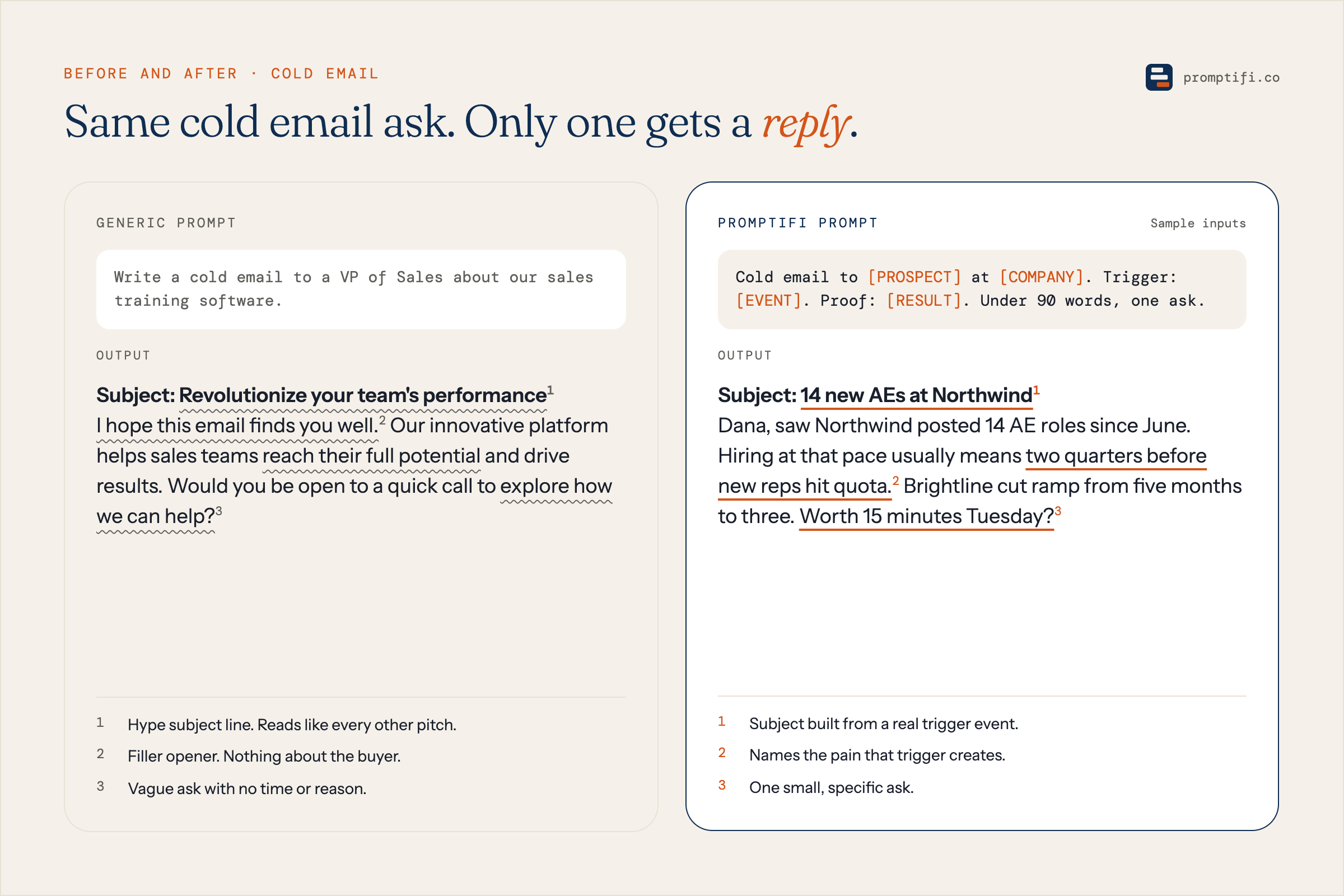
Cold email earns the open when it starts from something that actually happened. These five run on real signals: new hires, funding, launches, job posts, market shifts. If your bottleneck is finding the signal in the first place, the SDR prospecting prompts collection is the list-building layer that feeds this folder.
The Promptifi Team
The First-90-Days Opener
Use this when a target account just hired or promoted the executive who would own your deal.
From: The Promptifi Team <prompts@promptifi.co>
To: you
Re: The First-90-Days Opener
You are an SDR writing a cold email to [NEW EXECUTIVE NAME], who started as [JOB TITLE] at [PROSPECT COMPANY] within the last 90 days. I sell [YOUR PRODUCT] to [PERSONA] in [INDUSTRY].

New leaders audit what they inherited and hunt for wins they can claim inside two quarters. Write an email that connects one priority a new [JOB TITLE] typically owns in their first 90 days to a specific way [YOUR PRODUCT] helps, without pretending to know their internal plans.

Rules:
- 80 words maximum, four sentences or fewer.
- No congratulations line. Do not mention how long they have been in the role.
- Reference the inherited-priorities dynamic in one clause, not a paragraph.
- Close with one question, answerable with a yes or no.
- Plain language. No marketing adjectives.

Output: a subject line of 5 words or fewer, lowercase, then the email body. If you cannot infer the executive's likely priorities from my inputs, ask me up to 3 questions before drafting.
The Promptifi Team
Funding News, Minus the Confetti
Use this when the account raised a round and every other seller is sending congratulations.
From: The Promptifi Team <prompts@promptifi.co>
To: you
Re: Funding News, Minus the Confetti
You are writing a cold email to [PERSONA] at [PROSPECT COMPANY], which announced a [FUNDING STAGE] round on [ANNOUNCEMENT DATE]. I sell [YOUR PRODUCT].

The prospect's inbox is currently full of emails that open with congratulations. Do not congratulate them. Build the email on what funding actually changes: new headcount targets, new board expectations, and pressure to show progress on [LIKELY POST-FUNDING PRIORITY].

Rules:
- 90 words maximum.
- The word congratulations, and every synonym for it, is banned.
- The first sentence must name an operational consequence of the raise, not the raise itself.
- Connect exactly one consequence to [YOUR PRODUCT], in one sentence.
- Close with a low-commitment question that proposes a specific next step. Not a demo request.
- No exclamation points. No adjectives describing my product.

Output format: three subject line options, each under 6 words, then the email body. If [LIKELY POST-FUNDING PRIORITY] is blank, ask me for it before writing anything.
The Promptifi Team
They Just Shipped Something
Use this when the prospect launched a product or feature you can honestly tie to your offer.
From: The Promptifi Team <prompts@promptifi.co>
To: you
Re: They Just Shipped Something
You are a seller emailing [PERSONA] at [PROSPECT COMPANY] the week after they launched [PRODUCT OR FEATURE THEY SHIPPED]. I sell [YOUR PRODUCT], and the launch is relevant because [WHY THE LAUNCH CONNECTS TO YOUR OFFER].

A launch creates downstream work nobody announces: support volume, onboarding gaps, new reporting questions, a new sales motion. Write a cold email that names one specific piece of downstream work their launch likely created and positions [YOUR PRODUCT] as help for that work, not as admiration for the launch.

Rules:
- 85 words maximum.
- Mention their launch in one clause of the first sentence, then move on.
- The email is about their week after the launch, never about my product's feature list.
- Banned flattery words: impressive, exciting, love, amazing, huge.
- End with one question about how they are handling that downstream work.

Output: one subject line referencing the shipped thing in 4 words or fewer, then the body. If the connection between their launch and my product is not obvious from my inputs, ask me 2 clarifying questions first.
The Promptifi Team
The Job-Post Tell
Use this when their open roles quietly describe the exact gap your product covers.
From: The Promptifi Team <prompts@promptifi.co>
To: you
Re: The Job-Post Tell
Act as an SDR who reads job posts the way an analyst reads earnings calls. [PROSPECT COMPANY] currently lists [NUMBER] open roles for [ROLE TYPE], and the postings mention [PHRASE OR REQUIREMENT FROM THE JOB POST]. I sell [YOUR PRODUCT] to [PERSONA].

A job post is a public admission of a gap. Write a cold email to [PERSONA] that treats their hiring as evidence of the problem [YOUR PRODUCT] addresses. Frame it as a respectful observation, never a gotcha.

Rules:
- 90 words maximum.
- Quote no more than five consecutive words from the job post, inside quotation marks.
- The pivot sentence must be a genuine either-or: hire for the gap, or shrink the gap. Acknowledge that hiring may still be the right call for them.
- Never claim my product replaces the hire.
- One closing question, answerable in a single line.

Output: a subject line that does not contain the word hiring, then the body, then a one-line note on which variable most affects reply quality. If [PHRASE OR REQUIREMENT FROM THE JOB POST] is empty, ask me to paste the posting before drafting.
The Promptifi Team
When Their Market Moves
Use this when a competitor move, regulation, or price shift just changed the prospect's week.
From: The Promptifi Team <prompts@promptifi.co>
To: you
Re: When Their Market Moves
You are writing a cold email to [PERSONA] at [PROSPECT COMPANY] about [MARKET EVENT]: a competitor move, regulation, price change, or industry shift affecting [INDUSTRY]. I sell [YOUR PRODUCT], which matters here because [CONNECTION TO THE EVENT].

Most sellers will email a hot take. Write the email a well-informed peer would send instead: one specific, checkable observation about what [MARKET EVENT] changes operationally for companies like theirs, then one sentence on where [YOUR PRODUCT] fits that change.

Rules:
- 95 words maximum.
- The observation must be concrete enough that the prospect could disagree with it. Hedge words (might, could, potentially) appear at most once.
- No fear framing. Banned phrases: falling behind, cannot afford to ignore, wake-up call.
- Do not summarize the news. Assume they know it better than I do.
- Close by asking whether the observation matches what they are seeing.

Output: a subject line naming the event in 5 words or fewer, then the body. If I have not filled [CONNECTION TO THE EVENT], ask me for it and do not guess.
Problem-led angles
5 messagesNo trigger event? Then the problem is the trigger. These five open on a named pain, a workaround, a metric, or a scene from the buyer's day — researched guesses offered honestly, built to earn the correction reply.
The Promptifi Team
The Named-Problem Hypothesis
Use this when you have no trigger, just a well-researched guess about the problem they live with.
From: The Promptifi Team <prompts@promptifi.co>
To: you
Re: The Named-Problem Hypothesis
You are an SDR with no trigger event, writing a first-touch cold email to [PERSONA] at [PROSPECT COMPANY] in [INDUSTRY]. I sell [YOUR PRODUCT]. My problem hypothesis, in my own words: [PROBLEM HYPOTHESIS].

Write an email that states the hypothesis as a hypothesis — a specific, respectful guess about how [PROBLEM AREA] probably works inside a company like theirs — and invites correction. Being corrected is a successful outcome; a reply that starts with "not quite, actually" starts a conversation.

Rules:
- 85 words maximum.
- The hypothesis sentence must include one operational detail (a handoff, a spreadsheet, a meeting, a report) that shows real research, not a generic pain statement.
- Never claim to know their situation. Banned: I know, I am sure, obviously, clearly.
- One sentence maximum about [YOUR PRODUCT], placed after the hypothesis.
- Close by asking which part of the guess is wrong.

Output: a subject line phrased as the hypothesis in 6 words or fewer, then the body. If [PROBLEM HYPOTHESIS] reads generic to you, say so and ask me 2 sharpening questions before drafting.
The Promptifi Team
The Cost of the Workaround
Use this when the prospect is living with a duct-tape process instead of buying a fix.
From: The Promptifi Team <prompts@promptifi.co>
To: you
Re: The Cost of the Workaround
You are writing to [PERSONA] at [PROSPECT COMPANY], where the status quo for [PROBLEM AREA] is probably a workaround: [LIKELY WORKAROUND]. Common examples are spreadsheets, a shared inbox, or a standing weekly meeting. I sell [YOUR PRODUCT].

Write a cold email about the workaround, not the product. Describe the workaround's hidden tax qualitatively — the re-keying, the version confusion, the one person who becomes the bottleneck — in terms specific to [INDUSTRY]. No invented numbers, no fake ROI math.

Rules:
- 90 words maximum.
- Name the workaround in the first sentence as a neutral fact of life, not a failure.
- The tax description gets two sentences and must contain zero statistics.
- One sentence for [YOUR PRODUCT], framed as retiring the workaround.
- Close with a question about whether the workaround is still holding up.

Output: a subject line naming the workaround in 4 words or fewer, then the body. If [LIKELY WORKAROUND] is blank, ask me what their current process most likely is before drafting.
The Promptifi Team
A Tuesday in Their Shoes
Use this when you know the persona's day well enough to narrate the pain, not just name it.
From: The Promptifi Team <prompts@promptifi.co>
To: you
Re: A Tuesday in Their Shoes
Act as a seller who has sat next to a [PERSONA] for a week. I sell [YOUR PRODUCT] to [PERSONA] at companies like [PROSPECT COMPANY] in [INDUSTRY]. The moment in their day my product changes: [PAINFUL MOMENT IN THEIR DAY].

Write a cold email that opens inside that moment — second person, present tense, one specific scene ("It is 4pm, the pipeline review starts at 4:30, and the numbers live in three tabs") — then steps out of the scene to say plainly why I am writing.

Rules:
- 95 words maximum. The scene gets at most 35 of them.
- The scene must contain one concrete artifact of the job: a named report, tool, meeting, or due date typical for [PERSONA].
- Tone: knowing, dry, never mocking. The reader should feel seen, not surveilled.
- One sentence for [YOUR PRODUCT]. Zero feature lists.
- Close with a question that lets them correct the scene.

Output: a subject line drawn from the scene, 5 words or fewer, then the body. If [PAINFUL MOMENT IN THEIR DAY] is vague, ask me 3 questions about the persona's routine before writing.
The Promptifi Team
The Number They Answer For
Use this when you know which metric the buyer defends in every business review.
From: The Promptifi Team <prompts@promptifi.co>
To: you
Re: The Number They Answer For
You are emailing [PERSONA] at [PROSPECT COMPANY]. The number this persona answers for in business reviews is [METRIC THEY OWN] — think pipeline coverage, net revenue retention, cost per ticket, or time to fill. I sell [YOUR PRODUCT], which affects that number by [MECHANISM].

Write a cold email organized entirely around their number. Open with the observation that [METRIC THEY OWN] is the line they defend every quarter. Then describe the causal chain by which [YOUR PRODUCT] moves it, in plain words, without promising any amount of movement or quoting any statistic.

Rules:
- 90 words maximum.
- Banned: every percentage sign, every multiplier, every invented benchmark.
- The mechanism gets exactly two sentences and must say what the prospect's team would stop doing or start doing.
- No adjectives describing my product.
- Close by asking what they currently use to move that number.

Output: a subject line containing the metric, then the body. If [MECHANISM] is empty, ask me to explain in one sentence how the product moves the metric, then draft.
The Promptifi Team
The Status-Quo Autopsy
Use this when you want the prospect to audit their own process before you pitch anything.
From: The Promptifi Team <prompts@promptifi.co>
To: you
Re: The Status-Quo Autopsy
You are writing a cold email to [PERSONA] at [PROSPECT COMPANY] whose goal is to make the reader run a 60-second self-audit of how [PROBLEM AREA] works today. I sell [YOUR PRODUCT], but this email barely mentions it.

Draft the email around three short audit questions the prospect can answer from memory — questions a sharp [PERSONA] in [INDUSTRY] would find fair, specific, and slightly uncomfortable. Good audit questions expose handoffs, wait times, and single points of failure.

Rules:
- 95 words maximum, including the questions.
- Format the three questions as their own lines, each under 12 words.
- The questions must be answerable without opening a tool or asking a colleague.
- [YOUR PRODUCT] appears once, in the final sentence, positioned as the company that works on exactly these three questions.
- No scoring, no grades, no quiz framing.

Output: a subject line phrased as the sharpest of the three questions, then the body. If [PROBLEM AREA] is too broad to write specific questions, ask me to narrow it first.
Proof-and-relevance angles
Relevance you can point at. A mirror-image customer, one hard proof line, their own published words, their stack, a shared room — the five fastest honest answers to "why are you in my inbox?"
The Promptifi Team
The Lookalike Customer
Use this when you serve a company the prospect would recognize as their mirror image.
From: The Promptifi Team <prompts@promptifi.co>
To: you
Re: The Lookalike Customer
You are writing a cold email to [PERSONA] at [PROSPECT COMPANY]. My company sells [YOUR PRODUCT], and we work with [CUSTOMER NAME], a company the prospect would recognize as similar on the axis that matters: [WHY THE CUSTOMER IS A CREDIBLE MIRROR]. Think size, sales motion, market, or stack.

Write an email built on structural similarity, not name-dropping. The point is not that [CUSTOMER NAME] is impressive; it is that their starting situation matched the prospect's, specifically: [SITUATION BEFORE].

Rules:
- 90 words maximum.
- Describe what changed for the customer in qualitative, operational terms: what their team stopped doing, started doing, or no longer waits for. Use a number only if I paste a customer-approved figure into [APPROVED RESULT]; if that is empty, use none.
- One mention of [CUSTOMER NAME] only.
- No superlatives about my product or the customer.
- Close by asking whether the mirror actually holds for them.

Output: a subject line pairing the two companies in 5 words or fewer, then the body. Ask me for [SITUATION BEFORE] if it is missing.
The Promptifi Team
One Line of Proof
Use this when you have a single, true, concrete proof point and want it to carry the whole email.
From: The Promptifi Team <prompts@promptifi.co>
To: you
Re: One Line of Proof
You are an SDR writing to [PERSONA] at [PROSPECT COMPANY]. I sell [YOUR PRODUCT]. My single strongest, verifiably true proof point is: [ONE TRUE PROOF POINT]. It could be a named customer, a deployment detail, a certification, or a capability we can demonstrate on request.

Write a cold email where that one line of proof does all the lifting. Structure: one sentence of relevance to the prospect, the proof line stated plainly, one sentence bridging the proof to their situation, one closing question.

Rules:
- 70 words maximum. Four sentences exactly.
- Do not decorate the proof. No adverbs, and no adjective stronger than "specific".
- The bridge sentence must say why this proof matters to a [PERSONA] in [INDUSTRY], not restate the proof.
- If [ONE TRUE PROOF POINT] contains a number, ask me to confirm it is verified and customer-approved before using it.
- The closing question must reference their situation, not my calendar.

Output: a subject line quoting up to 4 words of the proof, then the body.
The Promptifi Team
They Wrote It, You Read It
Use this when the prospect published a post, podcast, or talk you can answer with substance.
From: The Promptifi Team <prompts@promptifi.co>
To: you
Re: They Wrote It, You Read It
You are writing to [PERSONA] at [PROSPECT COMPANY], who recently published [CONTENT PIECE] — a post, a podcast episode, or a conference talk. Their core argument, in my words: [THEIR ARGUMENT]. I sell [YOUR PRODUCT], relevant because [CONNECTION].

Write the email a thoughtful reader sends, not a fan. Engage the argument: extend it with one implication they did not state, or respectfully push on one assumption. Then connect that implication to why I reached out.

Rules:
- 90 words maximum.
- Prove the reading through specificity: reference one particular claim or moment, quoting at most 6 consecutive words.
- Banned: great post, loved this, resonated, thought leader.
- The extension or pushback must be substantive enough to stand alone as a comment.
- My product gets one sentence, connected to the argument, never bolted on.
- Close with a question about the argument, not about booking time.

Output: a subject line referencing their piece in 5 words or fewer, then the body. If [THEIR ARGUMENT] is blank, ask me to paste or summarize the piece before drafting.
The Promptifi Team
The Stack Match
Use this when their visible tech stack tells you the fit is already provable.
From: The Promptifi Team <prompts@promptifi.co>
To: you
Re: The Stack Match
You are an SDR writing to [PERSONA] at [PROSPECT COMPANY]. From job posts, their site, or stack-detection tools, I know they run [TOOLS IN THEIR STACK]. I sell [YOUR PRODUCT], which fits that stack because [FIT REASON] — an integration, a shared data model, or a workflow adjacency.

Write a cold email where the stack observation is the relevance, stated once, without being strange about how I know. Use the tone of someone who works in the same ecosystem every day.

Rules:
- 85 words maximum.
- The first sentence names at most two tools from [TOOLS IN THEIR STACK] and the job those tools do for them.
- Explain [FIT REASON] in operational terms: what flows where, what stops being manual. No integration-count brags.
- Banned openers: "noticed you use" and every surveillance-flavored variant. Find a better first clause.
- Close by asking about the workflow between the named tools, not about a demo.

Output: a subject line naming one tool plus one outcome, 6 words or fewer, then the body. If [FIT REASON] is empty, ask me for it before drafting.
The Promptifi Team
The Shared Room
Use this when you share real context: an event, a community, an investor, a mutual connection.
From: The Promptifi Team <prompts@promptifi.co>
To: you
Re: The Shared Room
You are writing to [PERSONA] at [PROSPECT COMPANY]. We share real context: [SHARED CONTEXT] — the same conference, a community, a mutual investor, an alumni network, or a mutual connection who agreed to be named. I sell [YOUR PRODUCT].

Write a cold email that uses the shared room honestly. It explains why I chose them and buys about eight seconds of goodwill, nothing more. The email must still stand on its own relevance — one sentence on why [YOUR PRODUCT] matters to a [PERSONA] like them: [RELEVANCE REASON].

Rules:
- 80 words maximum.
- The shared context appears once, in the first sentence, stated as fact without inflating the relationship.
- Banned: we both know, small world, fellow, kindred.
- If [SHARED CONTEXT] involves a mutual person, use the exact permission phrasing I provide; if I provided none, stop and ask me before drafting.
- Close with a question a stranger could comfortably answer.

Output: a subject line naming the shared context in 4 words or fewer, then the body.
To: you
From: The Promptifi Team <prompts@promptifi.co>
Subject: The other 2,875 prompts
These 25 are one folder. The library is 2,900+.
Cold email is one motion. The full Promptifi library covers the rest of the selling day — discovery, cold calls, objection handling, negotiation, renewals — every prompt written to the standard you just read, categorized, and ready to copy.
It is a library, not a dashboard: look it up, copy it, get back to selling.
Pattern interrupts
5 messagesThe inbox has a rhythm; these five break it on purpose. Candor as the hook, a single question, an inverted PS structure, a filter that tells most readers to leave, and a guess you are willing to lose.
The Promptifi Team
The Honest Cold Open
Use this when you have no trigger, no proof, no shared room — only candor.
From: The Promptifi Team <prompts@promptifi.co>
To: you
Re: The Honest Cold Open
You are writing a cold email to [PERSONA] at [PROSPECT COMPANY] with no trigger event, no mutual contact, and no research hook worth faking. I sell [YOUR PRODUCT] to [PERSONA] in [INDUSTRY].

Write the honest version: an email that says, in its first sentence, that this is a cold email — and then makes the next twenty seconds worth it. The candor is the pattern interrupt; what follows must justify it. Build the middle on one plainly stated reason companies like theirs talk to us: [THE REAL REASON PROSPECTS BUY].

Rules:
- 75 words maximum.
- The admission gets one short sentence. No apology, and no "I know you get a lot of these".
- After the admission, zero cleverness: short declarative sentences only.
- Give the reader an explicit, graceful out in the final line, alongside the ask.
- Banned: quick question, touching base, just, sorry.

Output: a subject line that is honest without containing the words cold email, 4 words or fewer, then the body. If [THE REAL REASON PROSPECTS BUY] is empty, ask me for it before drafting.
The Promptifi Team
The One-Question Email
Use this when the whole pitch compresses into a single question only the right buyer says yes to.
From: The Promptifi Team <prompts@promptifi.co>
To: you
Re: The One-Question Email
You are writing the shortest useful cold email to [PERSONA] at [PROSPECT COMPANY]. I sell [YOUR PRODUCT]. The qualifying condition that makes someone our buyer: [QUALIFYING CONDITION]. The reason I picked this account specifically: [WHY THEM].

Write an email that is one sentence of setup and one question. The question must be built so that answering it — even with a no — tells me something true about their [PROBLEM AREA], and so that only a genuinely qualified buyer answers yes.

Rules:
- 50 words maximum. This is the hard constraint; respect it before all others.
- The setup sentence earns the question, drawn from [WHY THEM].
- The question is concrete and closed-ended. Not "thoughts?", not "worth a chat?"
- No product description at all. If the question is good, curiosity does that job.
- Sign off with a first name only. No title block.

Output: exactly two subject line options of 3 words or fewer, then the body. If [QUALIFYING CONDITION] is fuzzy, ask me to state who should say no to us, then draft.
The Promptifi Team
The PS-First Email
Use this when you want the postscript — the most-read line in email — to do the selling.
From: The Promptifi Team <prompts@promptifi.co>
To: you
Re: The PS-First Email
You are writing a cold email to [PERSONA] at [PROSPECT COMPANY] built backwards. In most emails the PS is the best-read line; in this one it carries the payload. I sell [YOUR PRODUCT]. The single thing I most want them to know: [CORE CLAIM]. The specific, low-effort thing I can offer by reply: [LOW-EFFORT OFFER] — for example a 5-line teardown, a checklist, or one benchmark question answered.

Write a deliberately modest body — two sentences of honest context about why I am reaching out, no pitch — followed by a PS that lands [CORE CLAIM] in one line, and a PPS that makes the offer.

Rules:
- 80 words maximum in total.
- The body must read complete on its own; the PS is a gift, not a trick.
- PS: one sentence. PPS: one sentence, no conditions attached to the offer.
- Banned: "one more thing", manufactured casualness, any pressure phrasing.
- The offer must be deliverable by reply email, not a meeting.

Output: a subject line teasing the PS in 5 words or fewer, then the body with PS and PPS. If [LOW-EFFORT OFFER] is blank, propose 3 options and ask me to pick one.
The Promptifi Team
The Self-Disqualifier
Use this when telling them exactly who should ignore you makes the right buyer lean in.
From: The Promptifi Team <prompts@promptifi.co>
To: you
Re: The Self-Disqualifier
You are writing a cold email to [PERSONA] at [PROSPECT COMPANY] that opens by disqualifying most readers. I sell [YOUR PRODUCT]. It is genuinely wrong for: [WHO SHOULD NOT BUY]. It is built for: [WHO SHOULD BUY].

Write an email whose first line tells the reader to delete it if [DISQUALIFYING CONDITION] is true — sincerely, not as reverse-psychology theater. The remaining lines speak only to the reader still here, in specifics: the situation [YOUR PRODUCT] is built for, and one operational sign they are living in it.

Rules:
- 85 words maximum.
- The disqualification must be real and checkable, not a humblebrag. "Delete this if your pipeline is already perfect" is banned energy.
- The sign must be concrete: something they saw this week, not an abstraction.
- No pivot to hype after the filter. The register stays even.
- Close by asking which side of the filter they are on.

Output: a subject line phrased as the filter in 6 words or fewer, then the body. If [WHO SHOULD NOT BUY] is empty, ask me for it first — this email cannot work without it.
The Promptifi Team
The Falsifiable Guess
Use this when you can make one specific, checkable claim about their business and offer to be wrong.
From: The Promptifi Team <prompts@promptifi.co>
To: you
Re: The Falsifiable Guess
You are writing a cold email to [PERSONA] at [PROSPECT COMPANY] built around one falsifiable guess. Based on [OBSERVABLE EVIDENCE] — their site, pricing page, job posts, product docs, or review-site presence — I believe: [SPECIFIC GUESS ABOUT THEIR OPERATION]. I sell [YOUR PRODUCT], which is relevant only if the guess is right.

Write an email that states the guess plainly, names the evidence in half a sentence, and stakes the conversation on it: if I am wrong, they win and I go away; if I am right, the next step is obvious.

Rules:
- 85 words maximum.
- The guess must be specific enough to be wrong. "You probably struggle with efficiency" is banned energy.
- State the confidence honestly: this is a read from the outside, not a diagnosis.
- The go-away promise is literal and takes one clause.
- One question closes it: am I right or wrong?

Output: a subject line phrased as the guess in 6 words or fewer, then the body, then one line telling me what additional evidence would sharpen the guess. If [OBSERVABLE EVIDENCE] is empty, ask me what I can see about this company, then draft.
Follow-up and breakup
5 messagesMost replies live after the first email — but only if the follow-ups carry their own weight. Five sends for the long middle and the graceful end. And when the reply finally comes back as a pushback, hand it to the AI prompts for objection handling collection.
The Promptifi Team
The Follow-Up That Brings News
Use this when the first email got silence and you refuse to send a bump.
From: The Promptifi Team <prompts@promptifi.co>
To: you
Re: The Follow-Up That Brings News
You are writing follow-up number [TOUCH NUMBER] to [PERSONA] at [PROSPECT COMPANY], who has not replied to my earlier email about [ORIGINAL ANGLE]. I sell [YOUR PRODUCT]. Since that email, this happened: [NEW INFORMATION] — a relevant release, a new customer in their segment, a fresh observation about their business, or a resource worth having.

Write a follow-up justified entirely by the new information. It must work for a reader who never opened the first email, while quietly rewarding one who did.

Rules:
- 70 words maximum.
- Banned: bumping, floating, circling back, top of your inbox, did you see my last email, and any reference to being ignored.
- The new information gets two sentences maximum and is given freely. No strings.
- Restate the original relevance in one clause, not a paragraph.
- Close with a different question than the first email asked.

Output: a fresh subject line — never a reply to the old one — in 5 words or fewer, then the body. If [NEW INFORMATION] is empty, tell me to wait until I have some, and suggest 3 places to find it.
The Promptifi Team
The Thread Revival
Use this when a conversation went warm, then quiet, and you need a reason to reopen the thread.
From: The Promptifi Team <prompts@promptifi.co>
To: you
Re: The Thread Revival
You are reviving a thread with [PERSONA] at [PROSPECT COMPANY] that went quiet [TIME SINCE LAST REPLY] ago. Context from the thread, pasted here: [THREAD SUMMARY OR LAST EXCHANGE]. I sell [YOUR PRODUCT]. What changed since we last spoke: [WHAT CHANGED].

Write a reply in the existing thread that reopens without guilt-tripping. Assume a good-faith reason for the silence — priorities shifted, the quarter ended, the champion moved on — and name the most likely one lightly, once.

Rules:
- 80 words maximum.
- Open with the changed thing, never with the silence.
- Reference one specific detail from [THREAD SUMMARY OR LAST EXCHANGE] to prove this is not a template.
- Offer a downshift: a smaller next step than wherever the thread died.
- Banned: any phrasing that implies they owe me a reply.

Output: the reply body only — it lives in the old thread, so no subject line — plus a one-line note on the best day and time to send it. If [THREAD SUMMARY OR LAST EXCHANGE] is empty, ask me to paste the thread first.
The Promptifi Team
The Unspoken-No Preempt
Use this when silence probably means a specific objection nobody has said out loud yet.
From: The Promptifi Team <prompts@promptifi.co>
To: you
Re: The Unspoken-No Preempt
You are writing a late-sequence email to [PERSONA] at [PROSPECT COMPANY] after [NUMBER OF TOUCHES] touches with no reply. I sell [YOUR PRODUCT]. In deals like this, the silent objection is usually: [MOST LIKELY UNSPOKEN OBJECTION] — too expensive, wrong timing, we already have a tool, or this looks like a lot of work.

Write an email that names the likely objection out loud, on their behalf, and answers it honestly in two sentences — including whatever partial truth makes the objection reasonable.

Rules:
- 80 words maximum.
- Name exactly one objection. Naming two reads as flailing.
- The answer must concede something true before it counters. No straw men.
- Do not claim to know why they went quiet; frame it as "if the hesitation is X".
- Close by inviting the correction: if it is a different objection, one line back settles it.

Output: a subject line naming the objection in 5 words or fewer, then the body. If [MOST LIKELY UNSPOKEN OBJECTION] is empty, ask me two questions about the deal context, then choose the likeliest objection for [INDUSTRY] and say why.
The Promptifi Team
The Open-Door Breakup
Use this when the sequence is over and the last email should be the one they remember kindly.
From: The Promptifi Team <prompts@promptifi.co>
To: you
Re: The Open-Door Breakup
You are ending a sequence with [PERSONA] at [PROSPECT COMPANY] after [NUMBER OF TOUCHES] unanswered emails about [YOUR PRODUCT]. Write the breakup email that closes the file with dignity and leaves the door open by name.

Structure: one sentence acknowledging I am closing the file; one sentence restating, without pitch, the single circumstance under which we would be worth a fresh look: [RE-ENGAGEMENT TRIGGER]; one sentence telling them exactly how to find us when that day comes.

Rules:
- 60 words maximum.
- Zero guilt, zero passive aggression. Banned: I guess, clearly not a priority, last attempt, one final try.
- No fake finality. Do not pretend the door closes forever, and no theatrical goodbyes.
- The re-engagement circumstance must be specific and observable, never "when the timing is right".
- Sign off warm and short.

Output: a subject line of 3 words or fewer, then the body. If [RE-ENGAGEMENT TRIGGER] is empty, derive the most likely one from what [YOUR PRODUCT] does and explain your reasoning in one line after the email.
The Promptifi Team
The 90-Day Re-Entry
Use this when the breakup happened, the door stayed open, and there is a fresh reason to walk back in.
From: The Promptifi Team <prompts@promptifi.co>
To: you
Re: The 90-Day Re-Entry
You are re-entering an account 90 or more days after a sequence ended without a reply. Audience: [PERSONA] at [PROSPECT COMPANY]. I sell [YOUR PRODUCT]. The fresh reason to return: [NEW TRIGGER] — a launch on their side, a change on ours, a shift in [INDUSTRY], or a new customer of ours they would recognize.

Write a re-entry email that reads like a first touch, not a resumed campaign. It never references the old sequence, the silence, or how long it has been. The new trigger carries the entire email, exactly as a fresh trigger-event email would.

Rules:
- 80 words maximum.
- Banned: as I mentioned, reaching back out, reconnecting, following up from before, it has been a while.
- Treat prior research as a quiet advantage: one detail from it may sharpen the specificity, uncredited.
- One sentence for [YOUR PRODUCT], adjusted to whatever changed since last time.
- Close with a question about the trigger, answerable in one line.

Output: a subject line about the trigger in 5 words or fewer, then the body. If [NEW TRIGGER] is empty, list the four trigger types above and ask me which applies.
How to use these ChatGPT prompts for cold email

Rules and filters · applied before sending
Fill every bracket with research, not guesses
The variables are the email. A [PROBLEM HYPOTHESIS] filled from a real job post beats a perfect template every time. Most of these prompts ask you questions when inputs are missing — answer them instead of skipping past.
One angle per prospect per send
Never stack a trigger, a problem, and a proof point into one email. Pick the folder that matches what you actually know about the account, and save the other angles for the follow-ups in Folder 05.
Hold the 90-word line
Every prompt here caps its draft length because a cold email is judged in a preview pane on a phone. If the model runs long, reply "cut it in half" before you edit a single word yourself.
Strip the adjectives on the way out
Read the draft aloud. Any word you would not say on a live call — delighted, innovative, thrilled to share — gets deleted. The prompts ban most of them, but models relapse under pressure.
Test folders against each other, not sentences
Run Folder 01 against Folder 02 on the same 50-account list and keep whichever angle earns replies. Angle beats wording. The wider ChatGPT prompts for sales collection applies the same discipline to every other sales motion.
ChatGPT prompts for cold email — FAQ
A thread with the Promptifi team · all replies shown
You wrote:
What is the best AI prompt for cold email?
The Promptifi Team replied:
The best cold email prompt is the one matched to your opening angle. If you have a real trigger event, use a trigger prompt like The First-90-Days Opener. If you have nothing but a hypothesis, start in the problem-led folder. There is no single best prompt — there is a best angle for what you know about the account.
You wrote:
Do these prompts work with ChatGPT, Claude, and Gemini?
The Promptifi Team replied:
Yes. All 25 prompts are plain text and model-agnostic. Paste them into ChatGPT, Claude, Gemini, or any capable model, replace the bracketed variables with your own research, and answer the clarifying questions the prompt asks before it drafts.
You wrote:
Are these cold email prompts really free?
The Promptifi Team replied:
Yes. Every prompt on this page is complete, visible, and copyable with no signup, no email gate, and no truncation. They are built to the same standard as the full Promptifi library, which holds 2,900+ prompts at $89/year or $12/month.
You wrote:
How long should an AI-written cold email be?
The Promptifi Team replied:
Shorter than the model wants to write. Most prompts here cap the draft at 90 words or fewer, because a cold email is judged in a preview pane on a phone. If a draft comes back long, ask the model to cut it in half before you edit a word yourself.
You wrote:
How do I personalize these prompts without fake flattery?
The Promptifi Team replied:
Feed them evidence instead of adjectives. Every prompt takes ALL-CAPS variables like [PROSPECT COMPANY] or [NEW TRIGGER], and most instruct the model to ask for missing inputs rather than invent them. Personalization is the research you paste in — the prompt just keeps the model honest about using it.